
NYC Community Schoolyards Featured in the NYTimes!
We were excited to see national attention recently focused on the value of child-centered playground design. The story highlights a design approach that has been at the heart of Studio HIP's Community Schoolyard work for more than 20 years—engaging students as active participants in creating greener, healthier, and more resilient places for learning and play.

A recent feature in the New York Times highlighted something we've known for years: when children are invited to help design their own schoolyards, the results are more creative, more inclusive, and more deeply connected to their communities. The story celebrated young people's voices in shaping playgrounds, reinforcing the importance of participatory design as a catalyst for healthier, more vibrant public spaces.
At Studio HIP Landscape Architecture, this philosophy has guided our work for more than two decades.
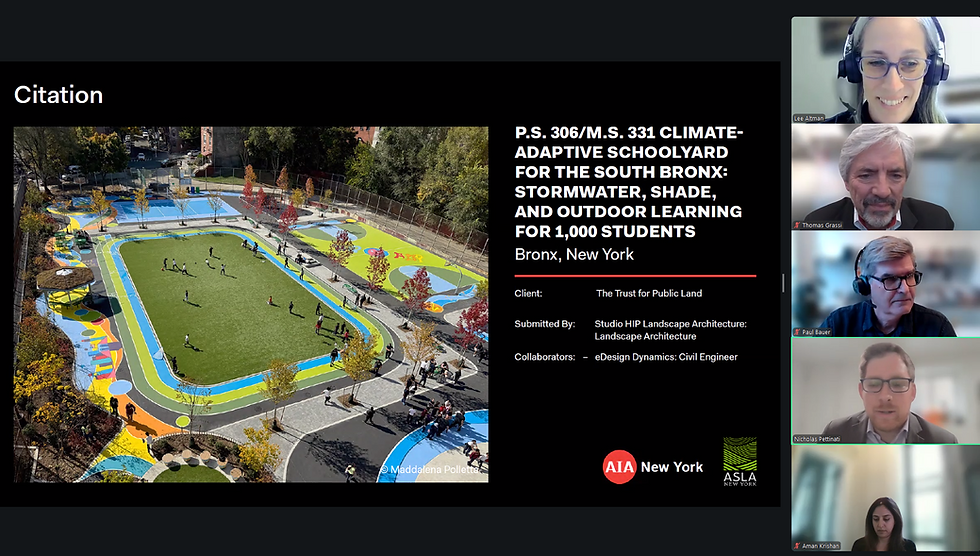
Through our long-standing partnership with the Trust for Public Land, the New York City School Construction Authority, and the New York City Department of Environmental Protection, we have helped transform more than 230 asphalt schoolyards into green community schoolyards throughout New York City's environmental justice neighborhoods.
These projects are far more than playground renovations. They are investments in children, neighborhoods, and the future resilience of our city.

Listening to the Experts
Who better understands how a playground should function than the children who use it every day?
Every Community Schoolyard begins with listening. Students, teachers, school administrators, families, and neighborhood residents participate in interactive workshops that encourage children to dream big while learning about design, ecology, and environmental stewardship.
Their ideas often inspire features adults might never imagine—from climbing structures and imaginative play areas to outdoor classrooms, gardens, nature exploration spaces, and gathering places that support both learning and community.
This collaborative process also gives students something equally valuable: ownership. When children see their ideas reflected in the final design, they develop a lasting connection to the space and a greater appreciation for the role they can play in improving their communities.
More Than a Playground
A well-designed Community Schoolyard delivers benefits that extend far beyond recess.
By replacing asphalt with trees, gardens, permeable surfaces, and green infrastructure, these spaces help:
• Reduce urban heat and provide much-needed shade.
• Capture and filter millions of gallons of stormwater.
• Improve air quality.
• Support biodiversity with native plantings.
• Create opportunities for outdoor learning.
• Encourage physical activity and mental well-being.
• Strengthen neighborhood connections by providing public open space after school hours.
For many New York neighborhoods, schoolyards represent the largest publicly owned open spaces available. When designed thoughtfully, they become community parks, environmental classrooms, and climate resilience infrastructure all in one.
Designing for Environmental Justice
Many of the communities we serve experience higher summer temperatures, increased flooding, poorer air quality, and limited access to parks.
Transforming these schoolyards addresses multiple challenges simultaneously.
The green infrastructure integrated into each project helps manage stormwater before it reaches the sewer system while increasing tree canopy, cooling surrounding neighborhoods, and creating healthier environments for students and residents alike.
These projects demonstrate that landscape architecture can improve public health, environmental resilience, and educational outcomes—all within a single site.
Building the Next Generation of Environmental Stewards
One of the most rewarding aspects of Community Schoolyard design is watching students discover that they can shape the places where they live.
Participating in the design process introduces young people to concepts such as sustainability, ecology, engineering, and landscape architecture while empowering them to become advocates for their neighborhoods.
Today's student designer may become tomorrow's planner, engineer, landscape architect, environmental scientist, or community leader.
Looking Ahead
As cities continue to invest in climate resilience and healthier neighborhoods, Community Schoolyards offer one of the most effective ways to achieve multiple public goals with a single investment.
At Studio HIP, we're proud to help create places where children can learn, play, connect with nature, and see their own ideas come to life. Every green schoolyard is an opportunity to build stronger communities—one child, one neighborhood, and one landscape at a time.

Comments